
What is Vedic Astrology?
Vedic Astrology is a divine science which is a chronicle for depicting the possible future events in one’s life in almost all the fields of one’s his life and living, along with the impact of surrounding happenings, which will include mundane, meteorology, horary astrology, etc. Mundane astrology refers to the world affairs and events. Meteorology astrology refers to the study of the Earth’s atmospheric and weather conditions involving rain and snow, conditions and effects of monsoon, floods, storms, tornadoes, hurricanes, tycoons and the like. Horary astrology is an ancient branch of horoscopy astrology, in which attempts are made by an astrologer to construct a horoscope for the exact time at which the query is received and then commented upon by the astrologer concerned about its results.
Astrology is an established limb of Vedas. In the Vedic context, it called as ‘Vedic Astrology’. It is equally known as “Vendange” (Anga-of- Veda). Vedas being our heritance, it is equally essential to mention here briefly that the word “Veda” has its roots in ‘Vid’, which stands for knowledge. The ancient extant text on Jyotisha is the Vedanga-Jyotisha.
Vedic scholars mention about the importance of the Vedangas, when they describe the Vedas as having six limbs as six “Vedangas”, ( the different sub parts of Vedas), these are:-
1. Shiksha: – It shows the path to the understanding of the ‘Vedic’ ‘Varnas’, Swaras’ and Mantras, thus leading one to modes of right pronunciation.
2. Kalpa: – It deals with the procedures of performing of religious rituals using the Vedic sutras and mantras.
3. Chhanda:- It ensures appropriate lyrical recitation of the Vedic ‘Suktas’.
4. Nirukta: – It explains the difficult words, ‘Padas’ and ‘Mantras’of Vedic terminology.
5. Vyakarana:- It shows the grammatical aspects of the Vedic language.
6. Jyotisha:- It refers to the movement of planets, constellations, with mathematical background known as ‘Ganita-Jyotisha’, with their effects on animate and inanimate beings, known as predictive astrology ( Phalita).
The Vedas while representing the cosmic body ( Kalapursha), (Jyotisha) represents its eyes, having visualization to see the past, present and future of a person or an event.
“Jyotish,” the official Sanskrit name for Vedic astrology, is one of the six Vedangas, and is called the “eyes of the Vedas.” Vedic astrologers in India believe that Jyotish represents the knowledge of the light of consciousness. The word “Jyotish” means light, and its experience empowers us to understand the relationship between matter and consciousness and experience the subtle balance between predestination and free will (karma). In astrological terminology, the Horoscope presents a precise roadmap to one’s future. Vedic Astrology or Jyotish has the unique power to tell us in exquisite detail as to what our unique spectrum looks like. Astrology’s premise is the planetary movements influencing the “Moments of Time”, during our living as humans. The planets continue to move, engaging with the earned energies of our past lives, to be consumed in this birth, which depict the various happenings and ups and downs in our life and living.
Astrology (Jyotisha), is further divided into three main sub divisions called as “Sakandas”, namely Ganita, Samhita and Hora. These are further classified as under:-
Ganita: – This first ‘Sakanda’ deals with the mathematical aspect of astrology. These are compiled into several compositions, called as “Siddantas”. These treatises called as ‘Siddantas” are about eighteen in number in ancient times. Varahamihira the great astrologer considers only five ‘Siddantas’, out of the total number of such ‘Siddantas’, in his famous astrological work known as “ Pancha Siddantika”. In this book, he writes about mathematical astronomy. He explains about the five earlier astronomical treatises by five authors, namely the ‘Paulisa Siddhanta’, ‘Paitamaha Siddhanta’, ‘Surya Siddhanta’, ‘Vasishtha Siddhanta’, ‘Romaka Siddhanta’. Thus, there are five “Siddantas”, and these are, “Surya-Siddhanta”, “Paulisha Sidhanta”, “Romaka Siddhana”, “Vasishtha Siddhanta” and “Paitamaha Siddhanta”. A prolific knowledge in these “ Siddhantas’, is a prerequisite for a competent astrologer as per sage Varamihara.
Samhita:- Samhita means a collection of the most generic context. Samhita refers to any methodical collection of text or verses. Any Shastra, Sutra, or Sanskrit epic, along with Vedic texts, is to be referred to as a Samhita. As for as astrology is concerned , these encompass varied areas, like weather forecasts, natural phenomenon’s like earth quakes, famines, epidemics, wars, changes in governments, international events, political and economic developments of nations through the planetary movements and combinations. Predictions for annual world happenings or of various countries, are generally based on the Hindu New Year commencing on ‘Chaitre Shukla Pratipada, or on the Solar Ingress into Aries and it falls under Samhita Astrology.
Hora:– This third ‘Sakanda”, deals with the individual horoscopes ( Jataka), which is used in natal predictive astrology of individuals for guidance. It also covers the “Muhurata”, a part of astrology, which refers to the choosing of favorable planetary combinations to regulate and achieve favorable results in one’s day to day working or actions. A ‘Jataka’ (horoscope) of a person is compiled on the basis of the date, time and the place of birth of a person. These three variables should be quite accurate for the compilation of one’s horoscope, which is not the natal birth chart only, but constitutes other divisional charts too, which are very vital for predictive purposes.
Astrologers of good and sincere essence need to offer prayers to the Lord Ganesha, who is the lord of intelligence, Mother Saraswati, who is the Goddess of knowledge and its learning, to attain proficiency in the mathematical astrology, which is the basis of astrological predictions.
Astrology can be baffling at first instance, because it involves a committed kind of wisdom, yet, if studied with devotion and commitment to its basic values, one will find it very much educative as for as it’s cosmic and predictive values are concerned. Astrology and its study have been declared something like a superstitious belief by neo- scientists. Such so called scientists calling themselves as the born pillars of science and its applications on a self assumed belief, have most of the times criticized astrology, when they have never bothered to study this subject as a subject of science, where the cause and effect principle of science gets applied fully. While defining science, it means knowledge and observations of critical systems and objects, verified through critical experimentations and tests of sorts along with its similar replications. It thus gets systematized and generalized as a subject called as a subject of science. Astrology and its study has a similar base. It fulfills both the criteria’s of cause and effect and its replication.
Cause & Effect: – While physical science being an outcome of cause and effect, as per the scientists, they thus ridicule astrology as a myth. This phenomenon of theirs refers to the laboratory testing of various phases of the events of science. They are ignorant about the fact that astrology is a cosmic science, where the limitations of the laboratory testing of events are very vast. In fact, the whole cosmos is the testing laboratory for the scientific testing of astrological norms and narratives. In the case of physical sciences, a cause may be gross or subtle in its form, showing results, which are in the shape of physical or gross, effects instantaneously. In the case of astrology the cause is always subtle, while the predictable or predictive results are varied, according to settled astrological norms and predicaments which are century old developed and defined axioms in this regard. The subtle cause in astrology has reference to the cosmic forces, which are defined by the placement of various planets in the birth chart of a person, which is prepared just at the time of his/her birth. Equally, astrology deals with multiple problems and phenomena’s upon earth. It being so, various astrological parameters and methods need to be applied with caution and precision, before an astrologer can be able to give correct predictions. Predicting in astrology is thus very difficult, when an astrologer has to be very much learned having varied knowledge of astrology. The subtle cause may be one, but the effective results can be varied, depending upon the individual horoscopes, as per typical planetary combinations in the individual horoscopes. Unfortunately since quacks have cropped in this field of astrology as astrologers, their failures to predict correctly has made astrology as a failed science when it is not so. These so called Pundits of the road, while projecting themselves as astute fortune tellers have defamed this pious and cosmic science.
Replication Effects:- The neo scientists claim that the physical sciences have replications of its various principles, when astrology and its principles do not possess so. It is necessary to mention here that every astrological prediction carry the phenomena of replication. Astrology being a complex science, all the known astrological principles are to be applied carefully. In ancient Vedic scriptures, numerous astrological dictums lie hidden. Once applied carefully, they show their applicability fully and give comprehensive results of their replication. During world war-I, word war-II and subsequent wars of 1965, 1971 between India and Pakistan and the like, typical astrological planetary combinations akin to each event of such a war or happening, gives enough credence to the fact of the replication effects of planets in astrology. It is on the basis of such anticipated planetary combinations in future, the most veteran astrologers of our country, have been able to predict the anticipated good or bad happenings in anticipation for future times.
Astrology and Karmic Effects:- Our ‘Karmas’ are an outcome of our good or bad deeds. Here comes the concept of cause and effect in operation in astrology. If there is an effect of some good or bad event in one’s life today, it has a cause preceding it. Every good or bad event of today in one’s life is linked to his or her actions “Karmas’, of the past. Certain actions “Karmas” of a person give immediate results. Some such actions “Karmic doings”, may take time in its fructifications. Once the belief of cause and effect is understood or felt by a person in his day to day doings, he or she will certainly limit one’s such actions to good deeds only for a better tomorrow. With better doings ‘Karmic” actions in this life ((Janama) for a person, is a better investment to have a good rebirth in next life ( Janma), when it may even mean to be a cause for avoiding subsequent births and rebirths. The astrology gives clues to such good or bad actions called as (Karmic actions) of the past, of a person, while delineating the present good or bad events in one’s present life (Janama). In fact our ‘Karmic actions’ decide our destiny
Brief about the Planets, Rashi’s and Nakhshtras
Planets
The nine planets, Sun, Moon, Mars, Mercury, Jupiter, Venus, Saturn, Rahu and Ketu, contribute to the different houses of a horoscope astrologically, once getting placed in various houses of a horoscope, as per the planetary position of that event of the birth of a person or any epoch. It is thus essential to understand the individual characteristics of these planets. ( Rahu and Ketu though imaginary points are taken as planets for knowing their characteristic ( significations) for the purposes of their astrological role while getting placed in a house of the horoscope, for predictive purposes.
(A)—–The general significations of these planets are described as under:-
Sun:-
Sun owns Leo sign. Sun has Satwick or benevolent temper. Sun represents soul, body, self realization, power, valor, health, physical strength, general wellbeing, father, comforts of father, king, kingly pursuits, kingdom, royal and royal fervor, politics, honor, splendor, fame and honor, courage, awakening of knowledge, enlightenment, administration, enthusiasm, competence, mental puritans, world of mortals, capturing foes, competence, leader, devotion to Lord Shiva, travelling, medical science, physician, electricity, summer, forests, mountains, river banks, trees, face, body, anger, hostility, indignation, ornaments, gold, pearls, copper, ruby, gem stones, timber, saffron, lotus, cow, strong at noon, eastern direction and right eye etc. As per the four casts, Sun represents ‘Kshatriyas’ cast. Sun is one of the major planets of planetary cabinet, which counts a lot in the astrological predictions, as Sun represents some of the vital parameters of a person in his or her horoscope. Sun is masculine in gender.
Moon:-
Moon owns Cancer sign. Sun has Satwick or benevolent temper. Sun representing soul, Moon is the mind (Manas). Moon is the significator of mind, mother, comforts from mother, emotions, sleep, happiness, affluence, luster, royal favor, wealth, travel, name and fame, heart, left eye, comfort through finances, beauty, sharp intellect, longevity, facial luster, nature of the mind, contentment etc. Moon represents intelligence, royal favors, beauty, happiness, sleep, sense of humor, capabilities, mental agility, nature, control over one’s mind, modesty, kindness, love, vehicles, laziness, sense of humor, liquids, water, fineness of one’s dress, milk, honey, fruits, fishes, aquatic animals, flowers, perfumes, pearls, perfumes, silver, pleasures, splendor, energy, snakes, reptiles, wheat, diamonds, sugar cane, rice, lakes, pilgrimages, middle age etc. As per the four casts, Moon represents ‘Vaishya’ cast. Moon represents north west direction, Moon has enough importance in astrological predictions, when apart from the main lagna chart, Moon representing the mind, thus Moon chart is also analyzed for astrological predictive purposes. Moon represents worship of “Gauri”, the consort of ‘Shiva’. Moon is feminine in gender.
Mars:-
Mars owns Aries and Scorpio signs. Mars is Tamsick in character. Mars is the significator of stamina, courage, strength, valor, desires, determination, anger, scandals, diseases, body strength, pride, ruling over people, administration, administrative capabilities, leadership of a village or town, commander of an army, men in high positions, ruler ship, carrying weapons, virility and its loss, oppositions, foes, charitable nature, ruler over religious places, archeologist, geologists, religious endowments, controversies and arguments, obstinacy, foolishness, fame, victory over enemies, skill of handling of weapons, risky adventures, leadership qualities, archery, criticism of others, army, cruelty, adultery, enemy’s strength, capacity to award punishments, speech, fickle nature, imbalance of mind, fire, ailments, wounds, accidents, injuries by weapons and burns, blood, surgery, land, immovable properties, army, men in uniform, police, wars, controlling wild animals, relatives like cousins, younger brothers and sisters, leadership, doctors, scientists, mechanical engineers, dental treatment, etc. Mars also signifies eating non vegetarian foods, summer, heat, service under a ruler, land, buildings, builder, estates agent, burnt place, earthen ware, gold, goldsmith, copper, snakes, red color, poison, pungent taste, trees etc. As per the four casts, Mars represents ‘Kshatriyas’ cast and south direction. It is Masculine in gender.
Mercury:-
Mercury owns Gemini and Virgo signs. Mercury is Rajasika in character. Mercury is the significator of speech, education, intelligence, oratory expression, oration, good conversation, learning, mathematics, accounts, grammar, logic, astrology, astronomy, philosophical knowledge, power of expression, writing, publishing, dancing, drama, discrimination, medical profession, trees, precious stones, charm, arguing, computer education, mathematics, auditors, secretaries, brain, diplomacy, planning capacity, politics, varied capabilities, gemology, etc. In addition to above, Mercury is the significator of editorship, journalist, minister, trader, trade and commerce, treasury, pilgrimages, sculptor, temples, religious rites, mental aptitude, knowledge of ‘Vedas’, knowledge of religious scriptures, black magic, mantra skills, renunciation, tantric pursuits, self control, horses, birds, autumn, or the beginning of winter, , green color, eunuch etc. Mercury also signifies a prince, maternal uncle, maternal grandfather, younger siblings, physician, temples, precious stones etc. Mercury represents chartered accountants, financial experts, merchants etc. Mercury gives the knowledge of ‘Mantras’ and ‘Yantras’. Going for pilgrimages and the building of temples is the signification of Mercury. Mercury is linked to the ‘Vaishyas’ as per the cast system. Mercury represents northern direction Mercury indicates the skills of a person in the testing of precious stones and makes a person a powerful tantric.
Jupiter:-
Jupiter owns Sagittarius and Pisces signs. Jupiter is Satwick in character Jupiter is the significator of wisdom, intellect, learning, logic, philosophy and philosophers, philosophical learning, sharpness, religious merit, wealth, treasure, riches, happiness, knowledge, good qualities, high standard of life, advisors, honor from the king, royal throne, ministers, status, knowledge of Vedas, religion, dharma, righteousness, good conduct, judiciary, law and its learning, indulging in good acts, affection. Jupiter also signifies preachers, shastras, religious learning’s, religious heads, religious preaching’s, authors of books, knowledge of mantras, performing religious and moral acts, elders, progeny, elder brothers and sisters, grandfather, grand children, husbands for females, disciples, honor and titles received from government, national awards, friends, justice, managerial capacity, lecturers, college principals, vice chancellors, legal experts, fortunes, discriminatory capacities. Jupiter also signifies, judges, advocates, legal experts, management experts, bankers, spirituality, spiritual saints, spiritual thinking, higher education, astrology, astronomy, broadmindedness, political diplomacy, control over senses, scriptures, corpulence, indignation, arrogance, fruity trees, etc. Jupiter represents the divine source. Jupiter also signifies, devotion, doing good to others, impartial outlook, charity, penance, places of pilgrimages, physical health, yellow topaz, yellow color, precious stones, gold, honey, decorations, salt and turmeric, cows, buffaloes, elephants, etc. It has the status of ‘Brahmin’ as per the caste classification. Jupiter represents northeast direction and the early half of winter.
Venus:-
Venus own Taurus and Libra signs. Venus is Rajasika in character. Venus is the significator of wife, marriage, females, sexual pleasures, sensual pleasures, conjugal bliss, genital organs, perfumes, luxuries, sex pursuits, ornaments, jewelry, articles of luxury, wealth, vehicles and conveyances, jewelers, textile, dress, jewels, flowers, flowering trees, beauty, buying and selling, cows, watery places, film industry, dancing, dancers, drama, dramatists, literature, culture, business involving females, music, singing, hotels, hoteliers, honor, respect, honorary titles, fame, fortune, status, kingdom, royal favors, high standard, tasty food, drinks, theaters, foreign pleasure tours, studios, bedrooms, keen intellect, keen knowledge, poets, poetry, literature, epics, musical compositions, photography, make ups, beauty parlors, tenderness, underground wealth, speculations, etc. Jupiter also signifies, overindulgence in sex, sexual perversion, adultery, affairs with many women, beauty, youth, perfumes, dealing in perfumes, beautiful cloths, fortune, radiance, fragrance, ornaments, diamonds, pearls, physical comforts, fine arts, elephants, horses, cattle, musical instruments, ancient culture, agriculture, servants, swimming etc. Venus represents southeast direction and the spring season. Venus as per caste system falls in the ‘Brahmin’ group. Venus shows the middle age and other family members and their prosperity. The family prosperity is seen from Venus. Venus is strong in the afternoon. Venus represents computer-software’s, in the modern context.
Saturn:-
Saturn own Capricorn and Aquarius signs. Saturn is Tamsick in character Saturn is the significator of longevity, life death, adversity, calamities, disrespect, diseases, poverty, livelihood, fear, employment, one’s profession, obstructions, distress, humiliations, stupidity, enmity, sorrow, punishments, allegations, fate, bad conduct, illiteracy, tiredness, indignations, bad postures, ugly figure, shabby looks, falsehood and deceit, cruelty, sinful actions, friends of the wicked, evolution of life in stages, labor, laborer’s, bodily efforts, expertise in science, agriculture, minerals, metals, oil hidden below ground, archeology, servants, slaves, old people, theft, uncourteous acts, over greed, provocations, temptations towards politics, leaders in politics, etc. Saturn represents professional skills of law and judiciary, justice, administration of justice, philosophical bent of mind, detachment and renunciation etc. Saturn shows old age, indebtedness, penury, income from infamy sources, companionship with the wicked, favors from the inferiors, wandering tendencies, slavery, horses, elephants, goats, buffaloes, dogs, oil wood, steel, iron, machines, workshop, head of iron related industry, black grains, precious stones, agriculture and farming, tamsik qualities, happiness from woman, unending difficulties and sorrows, rotten eatables, etc. Saturn also signifies, danger, accidents, spoiled character, unjust behavior, lameness, handicapped, glass, manure, grain, salt, the servant class, laborers, thefts, hard heartedness, etc. Saturn represents democrats. If Sun is the aristocrat, Mars is the dictator, Saturn is the democrat. In astrological language, Saturn has been described to be a cruel planet only, but there is a positive side of Saturn too, when it works as a mentor and a modifier for a person in his or her life. Saturn is reformative in its character. Saturn balances the good and bad, win and loss. So, it is called the God of justice. Saturn is a hard taskmaster. It instructs us to work hard, be disciplined. If we want success in life, then discipline should be the virtue for this. Saturn bestows salvation and liberation from the shackles of birth and rebirth. Saturn is the planet of bestowing the ecstasy of spirituality to a person. Saturn represents western direction, second half of winter and represents ‘Shudras’ as per the classification of the casts.
Rahu:-
Rahu signifies false hood, faulty logic, an irreligious behavior, irrelevant arguments, sudden happenings, restlessness, dependence on low people, benefits from outcastes and inferiors, foreigners, harsh speech, gambling, travelling, foreign travel, long travel, pilgrimages, wickedness, sins, outcasts, wicked thoughts, very low cast people, etc. Rahu also signifies snake bites, dreams, thefts, widow, skin diseases, itches, theft, eczema, acute pain in body, poison, smuggling, rituals of black magic, going to mountains, old age, poison, hesitation, wandering, south west direction, paternal grandparents, gambling, emerald, forests, disasters, technical education, knowledge of politics, etc. (Uttara-Kalamritta) mentions maternal grandparents as well being represented by Rahu).
Ketu:-
Ketu is the significator of worship of the lord of Chandi, Ganesha and others, spiritual and divinity, knowledge of self, knowledge of mantras’, involvement in tantras, secretive learning, renunciation, detachment, religious philosophy, knowledge of Vedas, great penance, bathing in Ganges ( holy rivers), pilgrimages, Vedanta knowledge, “Moksha” etc. Ketu also indicates medical practitioners physicians, surgical treatments, incurable diseases, trouble from enemies and detractors, injury, consumption, pain, fever, wounds, witchcraft, causing trouble to enemies, skin diseases, philosophy, self-realization, Vedanta knowledge, maternal grandfather, vultures, dogs, deer, cocks, horned animals, thorns, stones, hunger, small pox, boils, association with the ‘Shudras’, etc.
Planets as Significators ( Karkas) for various houses.
| Serial No. | House | Planet |
| 1 | First House | Sun |
| 2 | Second House | Jupiter |
| 3 | Third House | Mars |
| 4 | Fourth House | Moon, Venus, Mercury |
| 5 | Fifth House | Jupiter |
| 6 | Sixth House | Mars and Saturn |
| 7 | Seventh House | Venus |
| 8 | Eighth House | Saturn |
| 9 | Ninth House | Jupiter, Sun |
| 10 | Tenth House | Sun, Jupiter, Mercury, Saturn |
| 11 | Eleventh House | Jupiter |
| 12 | Twelfth House | Saturn |
( Rashi’s):-
There are 12 parts of a zodiac known as Rashis or Signs. These Rashis are owned by different planets, like Sun and Moon own Leo and Cancer, Mars owns Aries and Scorpio , Mercury owns Gemini and Virgo, Jupiter owns Sagittarius and Pisces, Venus owns Taurus and Libra, when Saturn owns Capricorn and Aquarius. Sun and Moon are called as ‘Ekadipati’ as they each own one rashi only.
These rashis have further significations for purposes of predictions and the effects of various planets in these rashis count a lot in astrological assessments. It is as such necessary to know various characteristics of these rashis (signs).
Nature of Rashis:-
These 12 rashis are classified in three groups as per their nature, viz, Movable, Fixed and Dual.
| Nature | Rashi |
| Movable (Char) | Aries, Cancer, Libra, Capricorn, 1,4,7,10 |
| Fixed (Sthir) | Taurus, Leo, Scorpio, Aquarius, 2,5,8,11 |
| Dual (Dwiswabhava) | Gemini, Virgo, Sagittarius, Pisces, 3,6,9,12 |
Tatwas of Rashis:-
These 12 rashis are classified in four groups as per their Tatwas, Fiery, Earthy, Airy and Watery.
| Rashis | Tatwas |
| Aries, Leo, Sagittarius, 1,5,9 | Fiery (Agni) |
| Taurus, Virgo, Capricorn, 2,6,10 | Earthy (Prithvi) |
| Gemini, Libra, Aquarius, 3,7,11 | Airy (Vayu) |
| Cancer, Scorpio, Pisces, 4,8,12 | Watery (Jal) |
Sex of Rashis:-
These 12 rashis are classified in two groups as per their Sex, (Male and Female).
| Rashis | Sex | Tatwas | Reaction |
| Aries, Gemini, Leo, Libra, Sagittarius and Aquarius | Male | All Agni and Vayu Rashis, and all odd rashis. | These male signs are dominating and aggressive. |
| Taurus, Cancer, Virgo, Scorpio, Capricorn and Pisces | Female | All Jal and Prithvi rashis and all even signs | These female signs are mild and submissive in nature. |
Directions and the cast of Rashis:-
These 12 rashis are classified in four groups as per their Directions, East, South, West, and North, when as their cast these are again classified in four groups, like, Brahmins, Kshatriyas, Vaishyas and Shudras.
| Rashis | Tatwa | Direction | Cast |
| Aries, Leo, Sagittarius, | Agni | East | Kshatriyas |
| Taurus, Virgo, Capricorn | Prithvi | South | Vaishyas |
| Gemini, Libra, Aquarius | Vayu | West | Shudras |
| Cancer, Scorpio, Pisces | Jal | North | Brahmin’s |
Body parts & the shapes represented by these Rashis:-
| Sign | Parts of Body |
| Aries | Head |
| Taurus | Face and Neck |
| Gemini | Arms, Upper Chest, Shoulders |
| Cancer | Chest, Breast, Lungs, Upper portion of Stomach |
| Leo | Heart, Lower portion of Stomach below chest and above Naval |
| Virgo | Upper Abdomen, Hips upper & below Navel |
| Libra | Lower Abdomen |
| Scorpio | Genitals, Anus, Other Private Parts |
| Sagittarius | Thighs |
| Capricorn | Knees and Back |
| Aquarius | Ankles, Calves of Legs |
| Pisces | Feet |
Constituent Character of Rashisr, (Dhatu, Moola, Jeeva status) ofRashis:-
These 12 rashis are classified in three groups as per their constituent character, which is Dhatu, Moola and Jeeva.
| Signs | Character-Constituent |
| 1,4,7 and 10 | Dhatu (Mineral) |
| 2,5,8 and 11 | Vegetable (Moola) |
| 3,6,9 and 12 | Animal (Jeeva) |
Biological Character of Rashis:-
These 12 rashis are classified in four groups as per their biological character, which is Quadruped, Biped, Insect, Jalchara.
| Signs | Character |
| 1,2, 5, posterior half of 9 and anterior half of 10 | Quadrupeds |
| 3,6,7,11 and anterior half of 9 | Bipeds |
| 8 | Insect |
| 4, 12 and posterior half of 10 | Jalchara |
Appearances and residing places of Rashis (Signs)
Brihat Prashara Hora Sahastra mentions that Sri Vishnu is invisible and time personified. His limbs are the twelve Rashi’s (Signs) commencing from Aries ( Mesha) up to Pisces ( Meena). These rashis are actually a cluster of stars, which are named after the shapes which ancient seers saw in them. There characteristics of their appearance and habitats are mentioned as under:-
Aries (Mesha):- Aries (Mesha) resembles a Ram. It is blood red in complexion. It has a big physique with round eyes. It is quadruped sign and wanders in hills and regions having precious stones and wealth. Aries sign wanders around lands full of grass and around lakes. It predominates in “Rajoguna”, when this sign is a cause of great activities in the human beings. It denotes courage and a great activity. It is strong during night. It is a Prishtodaya sign that is rising with its back, being fiery. It is ruled by Mars. It is symbolized by the image of a ram shown below:-

Taurus ( Vrisha) :- Taurus (Vrisha) resembles a bull. Its complexion is while. It is a long and a quadruped sign. Its places of residences are cow houses and farmlands. It is a Prishtodaya sign that is rising with its hind side. It is strong during night. It represents villages and businesspersons. It is ruled by Venus. It is symbolized by the image of a ram shown below:-

Gemini (Methuna):- Gemini ( Methuna) resembles a man and a woman, holding a mace and a flute. It is also represented by a man and a woman bearing a trumpet and a harp. It is a biped sign and strong in nights. It is a Shreeshodhya sign rising with its head. It lives in couches and the lounges, places of dancers, singers, artists, the places of sexual pleasures, gambling dens, indoor sports, etc. It has an even body and has green color. It is windy in its characteristics. Mercury rules it. A man and a woman bearing a trumpet and a harp as shown below represent it.

Cancer ( Karkata):- Cancer( Karkata) resembles a crab living in water. It is a centipede sign and has many feet and a bulky body. It is strong in nights. It is satwick in its character and is a watery sign. It is a Prishtodaya sign that is rising with its hind side. Its habitat is water filled places like gardens, river banks and wanders in forests. It has a whitish red color. It is ruled by Moon. It is symbolized by the image of a crab shown below:-

Leo (Simha):- Leo (Simha) is represented by a lion. It is a quadruped sign and equally a royal sign too. It is a Shreeshodhya sign rising with its head. It is strong during the day. It has a large white body. It has a satwick character. Its abode mostly is deep forests and mountains. It is ruled by Sun. It has a pale white color. It is symbolized by the image of a lion shown below:-

Virgo (Kanya):- Virgo (Kanya) is represented by a woman sailing in a boat, holding corn and a lamp in her hand in its appearance. It is a Shreeshodhya sign rising with its head. It is a biped sign. It is strong during daytime. It is virgin and has a Tamsick character (a disposition of demons). It resides in the places of enjoyment of women, pasturelands, lands full of water. It is multicolored with dark hair, is of dark color and dark eyes with good mental parameters. This sign is ruled by Mercury. It is symbolic image is shown below-

Libra (Tula):- Libra (Tula) is represented by a man with a balance in his hand in its appearance. It resides in markets, towns and buildings, places of business, offices and merchants houses. It resides in rich man’s places. It is fair in complexion, with a slender body. It is a Shreeshodhya sign rising with its head. It is strong during the day. It has a predominant Rajoguna. Venus rules Libra. It is symbolic image is shown below-

Scorpio ( Vrishchika):- Scorpio ( Vrishchika) is represented by a Scorpio in its appearance. It moves in crevice, pits, holes and water. It is a centipede sign. It is strong during daytime. It is reddish brown in color. It has a broad chest, with broad eyes. It is very sharp and passionate. It is a Shreeshodhya sign rising with its head. Mars rules Scorpio. It is symbolic image is shown below:-

Sagittarius (Dhanu):- Sagittarius ( Dhanu) is represented by a man armed with a bow and arrow, being radiant in its disposition. It resides in the places of authority, king’s residences, with elephants and chariots at its command, resorts and splendorous places. It is a royal sign, when it is biped in the first half and quadruped in the second half. It is powerful in the night and is Satwick in its characteristics. It is evenly build, with a long face and neck. It is liberal and cheerful. It is brownish in color. It is a Prishtodaya sign that is rising with its hind side. Its lord is Jupiter. It is symbolic image is shown below:-

Capricorn (Makara):- Capricorn (Makara) is represented by a picture like that of deer, with shoulders like those of a bull and eyes like those of an elephant. It moves in rivers, forests, water bodies and resides in oceans. It is strong in the nights and rises with its back (Prishtodaya sign). It has ‘Tamoguna’ characteristics. Its color is variegated. Its first half is quadruped and the second half is footless moving in water. Saturn is the lord of this sign. It is symbolic image is shown below:

Aquarius ( Kumbha):-
Aquarius ( Kumbha) is represented by a water bearer, wearing wet clothes and holding on his shoulder an empty pitcher. It resides in places frequented by potters, storehouses of pots, deep-water spots, places that are liquor-manufacturing spots and in drinking dens. It is deep brown in complexion. It is medium built. It is a biped sign. It is strong during the day. It is a Shreeshodhya sign that is rising with its head. It is Tamsick in its characteristics. Its lord is Saturn. It is symbolic image is shown below:-

Pisces ( Meena):- Pisces ( Meena) is represented by two fishes with their tails and heads in reverse position. It moves in the places of pilgrimages, holy places, rivers and oceans, where there are places of worships. It likes pious places, temples, and places of worships. It has violet color. This sign is strong at night. It has Satwak Guna as its characteristics. It denotes resoluteness. It is Ubhayodaya sign, which means rises with both head and back. It is footless and has a medium structure. It has a shining body. Jupiter is the lord of this sign. It is symbolic image is shown below:-

| Signs ( Rashi’s) | Shape represented | |
| Aries | Ram | |
| Taurus | Bull | |
| Gemini | A man and a woman, bearing a trumpet and harp | |
| Cancer | Crab which lives in water. | |
| Leo | Lion which resides in the mountains | |
| Virgo | A woman sailing in a boat, holding corn and a lamp in her hand, inhibits women’s pleasure rooms. | |
| Libra | A person with scale and balance in hand, and resides in lanes, markets, towns and buildings. | |
| Scorpio | Scorpio in appearance. It moves in crevices and pits. Its areas of residence include poisons, animal excreta, stones and insects. | |
| Sagittarius | Man armed with bow and arrow. Trained in horse riding and handling of arms and performing daring jobs and brave deeds. It resides in elephants and chariots. | |
| Capricorn. | Deer, with shoulders like those of a bull and eyes like those of an elephant. Moves in rivers and resides in oceans. | |
| Aquarius | Man, wearing wet clothes and holding on his shoulder an empty pitcher. It moves in gambling houses and resides in dinking dens | |
| Pisces | Two fishes with their tails and heads in reverse position. It moves in the places of pilgrimages and oceans. It likes pious places, temples, and places of worships. |
Nakshtras Constellations.
The Zodiac of 360 degrees as per Hindu astrology, is also divided into 27 sub parts known as the ‘Nakshtras’, which are the star constellations of 13 degrees and 20 minutes each. A Nakshatra is a group of stars and its name is based on one of the prominent identifying star in such a group. These Nakshtras are equally owned by various planets. Rahu and Ketu too are also allotted the ownership of the Nakshatras. Each Nakshatra is further divided into four ‘Padas’ or ‘Charnas’. As such, there are 108 Nakshtara Padas or quarters in the 27 Nakshatras. Each Nakshtara Pada or Charna measures 3 degrees and 20 minutes ( 3° 20′). As for as the Zodiac is concerned these 27 Nakshatras have a relationship with the 12 Rashi’s (Signs). These celestial luminaries make all the difference in astrological calculations. These constellations or the Nakshatras emerged as one of the most important components in Astrology. The names of these Nakshatras, extent of their longitudes in the Rashis, their planetary lords are shown in the table-4 below.
Table-1
| No. | Nakhshatra | Extent of Longitude Dig: min: to Dig: min: | Extent in Signs Sign- Deg: min: to Sign- Deg: min | Lordship |
| 1 | Ashwani | 00: 00 to 13: 20 | Aries 00:00 To Aries 13:20 | Ketu |
| 2 | Bharani | 13:20 to 26:40 | Aries 13:20 To Aries 26:40 | Venus |
| 3 | Kritika | 26:40 to 40:00 | Aries 26:40 to Taurus 10:00 | Sun |
| 4 | Rohini | 40:00 to 53:20 | Taurus 10:00 to Taurus 23:20 | Moon |
| 5 | Mrigshira | 53:20 to 66:40 | Taurus 23:20 to Gemini 06:40 | Mars |
| 6 | Ardra | 66:40 to 80:00 | Gemini 06:40 to Gemini 20:00 | Rahu |
| 7 | Punarvasu | 80:00 to 93:20 | Gemini 20:00 to Cancer 03:20 | Jupiter |
| 8 | Pushya | 93:20 to 106:40 | Cancer 03:20 to Cancer 16:40 | Saturn |
| 9 | Ashlesha | 106:40 to 120:00 | Cancer 16:40 to Cancer 30:00 | Mercury |
| 10 | Magha | 120:00 to 133:20 | Leo 00:00 to Leo 13:20 | Ketu |
| 11 | PoorvaPhalguni | 133:20 to 146:40 | Leo 13:20 to Leo 26:40 | Venus |
| 12 | Utra Phalguni | 146:40 to 160:00 | Leo 26:40 to Virgo 10:00 | Sun |
| 13 | Hasta | 160:00 to 173:20 | Virgo 10:00 to Virgo 23:20 | Moon |
| 14 | Chitra | 173:20 to 186:40 | Virgo 23:20 to Libra 06:40 | Mars |
| 15 | Swati | 186:40 to 200:00 | Libra 06:40 to Libra 20:00 | Rahu |
| 16 | Vishakha | 200:00 to 213:20 | Libra 20:00 to Scorpio 03:20 | Jupiter |
| 17 | Anuradha | 213:20 to 226:40 | Scorpio 03:20 to Scorpio 16:40 | Saturn |
| 18 | Jyeshtha | 226:40 to 240:00 | Scorpio 16:40 to Scorpio 30:00 | Mercury |
| 19 | Moola | 240:00 to 253:20 | Sagittarius 00:00 to Sag 13:20 | Ketu |
| 20 | Purva Ashadha | 253:20 to 266:40 | Sagittarius 13:20 to Sag 26:40 | Venus |
| 21 | Uttra Ashadha | 266:40 to 280:00 | Sag. 26:40 to Capricorn 10:00 | Sun |
| 22 | Shravana | 280:00 to 293:20 | Capricorn 10:00 to Cap 23:20 | Moon |
| 23 | Dhanishta | 293:20 to 306:40 | Capricorn 23:20 to Aqu. 06:40 | Mars |
| 24 | Shatbhisha | 306:40 to 320:00 | Aqu. 06:40 to Aquarius 20:00 | Rahu |
| 25 | PurvaBhadrapad | 320:00 to 333:20 | Aquarius 20:00 to Pisces 03:20 | Jupiter |
| 26 | Uttra Bhadrapad | 333:20 to 346:40 | Pisces 03:20 to Pisces. 16:40 | Saturn |
| 27 | Revati | 346:40 to 360:00 | Pisces 16:40 to Pisces 30:00 | Mercury |
>> Linking the Signs (Rashis) with the Nakhshtras, their extent of their longitudes, their Padas (Chranas) and their lords, the situation emerges as shown in the table-5 below:-
Table-2
| No | Sign (Rashi ) | Nakhshtra | Extents of Longitude Sign Degree Minutes | Padas | Lordship |
| 1 | Aries Mesha | 1. Ashwani 2. Bharni 3. Kritika | 0 13 20 0 26 40 1 00 00 | 4 4 1 | Ketu Venus Sun |
| 2 | Taurus Vrisha | 3. Kritika 4. Rohini 5. Mrigashira | 1 10 00 1 23 20 2 00 00 | 3 4 2 | Sun Moon Mars |
| 3 | Gemini Mithuna | 5. Mrigashira 6. Ardra 7. Punarvasu | 2 06 40 2 20 00 3 00 00 | 2 4 3 | Mars Rahu Jupiter |
| 4 | Cancer Karka | 7. Punarvasu 8. Pushya 9. Ashlesah | 3 03 20 3 16 40 4 00 00 | 1 4 4 | Jupiter Saturn Mercury |
| 5 | Leo Simha | 10. Magha 11. P. Phalguni 12. U.Phalguni | 4 13 20 4 26 40 5 00 00 | 4 4 1 | Ketu Venus Sun |
| 6 | Virgo Kanya | 12. U.Phalguni 13. Hasta 14. Chitra | 5 10 00 5 23 20 6 00 00 | 3 4 2 | Sun Moon Mars |
| 7 | Libra Tula | 14. Chitra 15. Swati 16. Vishakha | 6 06 40 6 20 00 7 00 00 | 2 4 3 | Mars Rahu Jupiter |
| 8 | Scorpio Vrischika | 16. Vishakha 17.Anuradha 18. Jyeshtha | 7 03 20 7 16 40 8 00 00 | 1 4 4 | Jupiter Saturn Mercury |
| 9 | Sagittarius Dhanu | 19. Moola 20. P. Ashadha 21. U.Ashadha | 8 13 20 8 26 40 9 00 00 | 4 4 1 | Ketu Venus Sun |
| 10 | Capricorn Makara | 21. U.Ashadha 22. Shravana 23. Dhanishtha | 9 10 00 9 23 20 10 00 00 | 3 4 2 | Sun Moon Mars |
| 11 | Aquarius Kumbha | 23. Dhanishtha 24. Shatabisha 25.P. Bhadrapad | 10 06 40 10 20 00 11 00 00 | 2 4 3 | Mars Rahu Jupiter |
| 12 | Pisces Meena | 25.P. Bhadrapad 26.U.Bhadrapad 27. Revati | 11 03 20 11 16 40 12 00 00 | 1 4 4 | Jupiter Saturn Mercury |
Navamash:-
A zodiac of 360 degrees has twelve signs and each sign of thirty degrees when divided in to nine equal parts then each part there of comprises of three degrees and twenty minutes. Each such part is called navamsha. This one ninth part of a zodiacal sign is called as navamsha and this chart is called as Navamsha chart or D-9 Chart. The word navamsha carries two words viz. Nav (nine) + Amsha (sub part), or nine sub parts and this is what is known as Navamsha. There are 108 navamshas (12 rashis x 9 amshas). Each navamsha is thus of 3 degrees and 20 minutes arc.
Navamash- Its Importance;-
It has further relevance to the nakshatras or the constellations. There are 27 nakshatras and each nakshatra has 4 padas. The same zodiac of 360 degrees when divided in to 27 parts viz. nakshatras, each nakshatra becomes of 13 degrees and 20 minutes arc. When this arc of 13 degrees and 20 minutes is further divided into 4 padas, each pada comprises of 3 degree and 20 minutes arc. This arc of each pada thus coincides with the arc of each navamsha and the arc length of both is 3 degrees and 20 minutes. To put it more mathematically, one navamsha or 1/9th part of a rashi (sign) represents one pada or 1/4th part of a nakshatra. Thus it is quite clear that one navamsha arc of 3 degrees 20 minutes is synonymous with one pada arc of 3 degrees and 20 minutes of a nakshatra. So each navamsha corresponds to one nakshatra pada. Both are not only of same arc length but their lines of demarcation are also the same.
For this reason alone one can conclude the importance of navamsha and its use in astrology. Navamsha varga is the most important vargas out of all the varga charts. Maharishi Parashara has accorded greatest importance to the navamsha and the emphasis of navamsha in Brihat Prashara Hora shastra is that it is the second best varga of the shodasavarga system or the 16 divisional charts.
Mantreswara in Phaladeepika, Kalyan Verma in Saravalli, Varahamihira in Brihat Jatka and Baidyanath in Jatak Parijat have all given prime importance to the navamsha chart while analyzing a birth chart for astrological analysis.
Similarly Sh.K.N.Rao the present day living icon of astrological testaments and an imminent astrologer of repute having authored volumes of books on astrology states that “the strength of a planet should be ascertained with a careful and precise study of the rashi and the navamsha charts.
While as it is mostly believed that the navamsha chart is the chart where from the marriage and the spouse of a person has to be seen, as also taking it as the indicator as to how a married life of person will be, along with studying the marital bliss, the married life and the conjugal happiness of person, it is equally the extension of the 9th house of the rashi chart.
The ninth house (bhava) of a birth chart represents the dharma bhava which means the abode of Lord Vishnu. Navamsha as the ninth part of rashi would indicate the dharma phala (results) as well. Hindu scriptures say that in our physical existence all the material and physical achievements of this world of false hopes (Maya) are to be left here only. It is the good deeds viz. the dharma which gets carried to our new and future births. One with out good deeds (dharma) will be devoid of the blessings of the heavens. It is the navamsha which shows the quantifications of the good deeds (dharma) of a person. So navamsha is one of the most vital vargas and its importance needs to be understood fully. It can equally be called as fortune chart.
Mantreshwar says that results from the navamsha are almost the same as that of the rashi chart. Man-Sagri says that all the aspects of life can be ascertained through navamsha. Some astrologers attach more importance to the navamsha chart.
Brihat Jatka deals mainly with the Shad vargas (six divisional charts) and Sage Parashara has given the Vimsopaka strength of 20 Rupas to these vargas as follows:-
Rashi chart: – 6 points, Hora chart:-2 points, Drekhna chart:-4 points, Navamsha chart:-5 points, Dwadashma chart:-2 points, Trimsamsha chart:-1 point. Thus the navamsha chart holds the second best position as per this Vimsopaka Bala (strength) is concerned. So it has a prominent place after the rashi chart.
It is said that:-
1). If rashi chart represents the body of a person, the navamsha chart represents the back bone there of.
2). If the rashi chart is the physical existence and the circumstances one lives in, with the Moon showing the mind and mental capacity, the navamsha chart is the force of destiny which decides as to what shall be the results of your efforts (Karma).
3). If rashi chart is the tree, the navansha chart is the fruit there of.
4). If rashi chart is just a photograph of person in terms of astrological findings, then the navamsha chart is the X-ray there of those astrological findings.
5). If rashi chart is the mahadasha, the navamsha chart is the antardasha there of.
6). If rashi chart is sthoola posture, then the navamsha chart is sookshama posture there of.
7) The navamsha is the tool that compliments the rashi chart, but it has to used not in isolation but with the rashi chart.
Navamsha and Zodiac.
12 rashis or 360 degrees constitutes the zodiac. One cycle of navamsha from Aries (Mesha) to Pisces ( Meena) would take (3degrees-20 minutes) x 12 =40 degrees. Thus a cycle of 12 navamshas will repeat after an interval of 40 degrees in the zodiac. So every navamsha from Aries (Mesha) to Pisces (Meena) will repeat 9 times in the zodiac after an interval of 40 degrees.
The average time taken by each planet to transit an arc of 3 degrees and 20 minutes viz. one navamsha is shown as under-
Sun: – 3 days- 8 hours, Moon: – 6 hours and 30 minutes,
Mars: – 4 days- 10 hours- 30 minutes, Mercury: – 2 days-5 hours-30 minutes
Jupiter: – 1 month-10 days, Venus: – 2 days-16 hours,
Saturn: – 3 months- 10 days, Rahu/Ketu: – 2 monts-2 days.
Navamsha Chart- Its Computation.
The time taken by one navamsha to rise in the east is 13 minutes and 20 seconds.
There are various methods of casting a navamsha chart and these are shown as follows-
Method No.1
For all movable (Char) rashis the navamsha begins from that rashi itself. For all the fixed (sthir) rashis the counting begins from the ninth sign there from. For all dual (diswabhawa) rashis the counting starts from the fifth sign there from.
Illustration:-
| Movable(Char)Rashi | Navamsha Counting From |
| 1-Aries (Mesha) | Aries (Mesha) |
| 4-Cancer (Kark) | Cancer (Kark) |
| 7-Libra (Tula) | Libra (Tula) |
| 10-Capricorn (Makar) | Capricorn (Makar) |
| Fixed (Sthir) Rashi | Navamsha Counting From |
| 2-Taurus (Vrishba) | 2+8=10 Capricorn (Makra) |
| 5- Leo (Simha) | 5+8=01 Aries (Mesha) |
| 8- Scorpio (Vrishchika) | 8+8=04 Cancer ( Karka) |
| 11- Aquarius (Kumbha) | 11+8=07 Libra (Tula) |
| Dual Rashi (Diswabhawa) Rashi | Navamsha Counting From |
| 3-Gemini (Methuna) | 3+4=7 Libra (Tula) |
| 6-Virgo (Kanya) | 6+4=10 Capricorn (Makra) |
| 9-Saggitarius (Dhanu) | 9+4=01 Aries (Mesha) |
| 12-Pisces (Meena) | 12+4=04 Cancer (Karka) |
Method No.2
For all fiery signs the counting of the navamsha starts from Aries (Mesha) sign. For the earthy signs the counting of the navamsha starts from the Capricorn (Makra) sign. Similarly for all airy signs the counting of the navamsha starts from Libra (Tula) sign and for all watery signs the counting of the navamsha starts from the Cancer (Karka) sign.
Illustration:-
| Sign | Nature of Sign | Navamsha Counting From |
| Aries(Mesha), Leo(Simha) Sagittarius(Dhanu) | Fiery | Aries (Mesha) |
| Taurus(Vrishbha), Virgo(Kanya), Capricorn(Makra) | Earthy | Capricorn (Makra) |
| Gemini (Methuna), Libra (Tula), Aquarius (Kumbha) | Airy | Libra (Tula) |
| Cancer (Karka), Scorpio (Vrishchika), Pisces (Meena) | Watery | Cancer (Karka) |
Method-3
This is a mathematical method of reckoning of the navamsha chart. In a rashi (sign) multiply the completed signs by 9 and then add to it the running navamsha division. Divide the arrived figure by 12. The remainder there of will give the rashi (sign) where the planet will be placed in the navamsha chart.
Illustration:-
Suppose the lagna is Scorpio (Vrishchika) with 10 degrees and 27 minutes as its longitudinal degrees, which means 4th navamsh division. The completed signs are 7 and by multiplying it with 9 we get a figure of 63 and adding 4 to it will make it 67. Dividing this figure by 12 the remainder is 7. So the lagna of the navamsha chart will be Libra (Tula). Similarly if a planet says Moon is placed in Aquarius (Kumba) sign with 22 degrees and 40 minutes as the longitudinal degrees, it means 7th navamsha division and 10 completed signs. So multiply 10 by 9 we get 90 as the figure and adding 7 to it the resultant figure comes to 97. By dividing 97 with 12 the remainder is 1. So the Moon will be placed in Aries (Mesha) rashi in the navmasha chart.
Navamsha Chart Table:-
| Sign>> Navamsha | 1 | 2 | 3 | 4 | 5 | 6 | 7 | 8 | 9 | 10 | 11 | 12 |
| 3d-20m | 1 | 10 | 7 | 4 | 1 | 10 | 7 | 4 | 1 | 10 | 7 | 4 |
| 6d-40m | 2 | 11 | 8 | 5 | 2 | 11 | 8 | 5 | 2 | 11 | 8 | 5 |
| 10d-00m | 3 | 12 | 9 | 6 | 3 | 12 | 9 | 6 | 3 | 12 | 9 | 6 |
| 13d-20m | 4 | 1 | 10 | 7 | 4 | 1 | 10 | 7 | 4 | 1 | 10 | 7 |
| 16d-40m | 5 | 2 | 11 | 8 | 5 | 2 | 11 | 8 | 5 | 2 | 11 | 8 |
| 20d-00m | 6 | 3 | 12 | 9 | 6 | 3 | 12 | 9 | 6 | 3 | 12 | 9 |
| 23d-20m | 7 | 4 | 1 | 10 | 7 | 4 | 1 | 10 | 7 | 4 | 1 | 10 |
| 26d-40m | 8 | 5 | 2 | 11 | 8 | 5 | 2 | 11 | 8 | 5 | 2 | 11 |
| 30d-00m | 9 | 6 | 3 | 12 | 9 | 6 | 3 | 12 | 9 | 6 | 3 | 12 |
The Horoscope & Its Constituents
The definition of a ‘Horoscope” as per English dictionary, means a diagram of the heavens, showing the relative position of planets and the signs of the zodiac, for use in foretelling the possible events and happenings both good or bad in a person’s life, a prediction of future events or advice for future behavior based on such a diagram, etc. It is mostly believed that a horoscope is a real way to divine the future, when the traits and circumstances are determined from the position of the planets at the exact moment of a person’s birth, or of any event having relevance to time. In astrological parlance, the word horoscope has a Greek root, ‘hōroskopos’, combining two words, Hora and Skopos. Hora indicates the “time or hour,” and the skopos, the “observer”. The horoscope is the chart of the heavens at a particular moment of time and place, indicating the scheme of the 12 signs of the Zodiac, with the planetary position in the various houses of the Zodiac at that particular moment of time and place. In this chart along with the various signs of the Zodiac, the relative position of the planets and the nakhshtras gets linked to these planets which in turn gets exhibited. This chart of the heavens is drawn for a particular epoch and place, which includes the birth of a newborn human life, an incident, thought or a query for a happening.
Ascendant or Lagna
As already mentioned, there are 12 signs of the Zodiac. The Zodiac sign which rises in the eastern horizon at the time of one’s birth, or any event, is called as the Ascendant or Lagna. It is the first house of the horoscope. The first house means the rising sign at the time of birth. Rests of the signs occupy the subsequent house in order of the sequence of the houses of Zodiac. To clarify it further it needs to be added here that the Earth rotates on its axis from west to east in about 24 hours. Because of this rotatory motion of the Earth, the entire Zodiac with planets and Nakhshtras located in it, appear to rise in the east and set in the west. As such all the 12 signs of the Zodiac, seem to rise in the eastern horizon one after the other in the 24 hours. As already mentioned above, the Zodiac sign which rises in the eastern horizon at the time of one’s birth, or any event, is called as the Ascendant or Lagna. The names of ascendants (lagnas), corresponds to the name of the sign (rashi) rising at a given point of time.
Various Forms of Horoscopes:-
There are three forms of horoscopes commonly in use in our country India. These may appear different in their form, but these convey similar characteristics. These are classifies as, North Indian Chart, South Indian Chart and the East Indian Chart. These are exhibited below- DOB; 26-07-2006, TOB;13:49:00, POB; Delhi
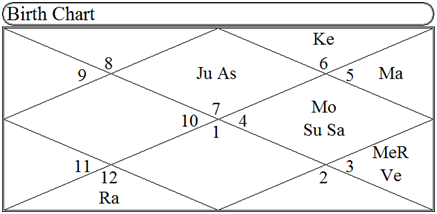
North Indian Chart
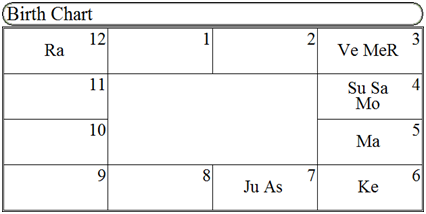
South Indian Chart
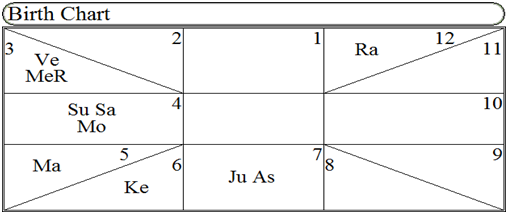
East Indian Chart
North Indian Chart:-
In this type of chart, the order of the houses is fixed. This type of the chart has 12 houses marked from 1st to the 12th house in its diagram in an anti clock wise manner. The ascendant is always in the first house at the top, being occupied by the sign rising at the eastern horizon at a particular point of time. The remaining signs are marked in a regular order in houses following the first house in an anti clockwise manner. Suppose the rising sign, which is the first house, thus the ascendant in this type of chart is Cancer, the 2nd , 3rd, 4th , 5th, 6th, 7th, 8th, 9th, 10th, 11th and the 12th house, in an anticlockwise direction from the 1st house, will be occupied by Leo, Virgo, Libra, Scorpio, Sagittarius, Capricorn, Aquarius, Pisces, Aries, Taurus and Gemini signs respectively. This type of horoscope format is commonly used in the northwestern India. The planetary positions of that moment are found out and placed in the respective houses. Various houses in this type of chart are shown in the diagram above.
South Indian Chart:-
In this type of chart, the signs (lagnas) are fixed in a regular order. The houses vary as per the ascendant (lagna). The ascendant (lagna) is marked with the appropriate sign rising at the eastern horizon. The remaining houses are counted in a clockwise order. The ascendant is marked with two traverse lines like //. Suppose the rising sign, thus the ascendant in this type of chart is Cancer, the 2nd , 3rd, 4th , 5th, 6th, 7th, 8th, 9th, 10th, 11th and the 12th house, from this sign in a clockwise direction from this sign the ascendant ( lagna), will be occupied by Leo, Virgo, Libra, Scorpio, Sagittarius, Capricorn, Aquarius, Pisces, Aries, Taurus and Gemini signs respectively. This type of chart is mostly in vogue in the south states of India. Various houses in this type of chart are shown in the diagram above.
East Indian Chart:-
This type of chart is a combination of the north Indian and the south Indian charts, where the signs (rashis) are fixed and the counting of houses is done in an anticlockwise manner. This type of chart is used in eastern states of India like Bengal and Orissa. Suppose the rising sign, viz, the ascendant in this type of chart is Cancer, the 2nd , 3rd, 4th , 5th, 6th, 7th, 8th, 9th, 10th, 11th and the 12th house, from this sign in an anticlockwise direction from this sign the ascendant ( lagna ), will be occupied by Leo, Virgo, Libra, Scorpio, Sagittarius, Capricorn, Aquarius, Pisces, Aries, Taurus and Gemini signs respectively. Various houses in this type of chart are shown in the diagram above.
Nine planets become the occupants of the houses in these different charts as per the planetary positions of that event. These 12 houses signify certain significations, when the various signs (rashis) representing these houses, equally represent certain significations. Such a combination produces certain astrological results, which get further modified by the planets falling in these houses. Thus while coming to certain astrological predictive conclusions, it is imperatively essential to know the significations of these houses, the various planets and the signs.
These rashis have further significations for purposes of predictions and the effects of various
Planets in these rashis counts a lot in astrological assessments. It is as such necessary to know various characteristics of these the various houses ( Bhawas), rashis (signs) and Planets etc. It has been discussed in detail in the chapters ahead.
Thank you for being a important part of our success. Your commitment motivates us every day.